The ceremony was about “respect for Ukrainian heroes”, Volodymyr Zelenskyy said about Melnyk, a leader of the Organisation of Ukrainian Nationalists (OUN) that sought to create an independent Ukraine and who died in West Germany in 1964.
Four days after the reburial – the Melnyks’ ashes had been exhumed from Luxembourg – Zelenskyy named an elite military unit after “the heroes of the Ukrainian Insurgent Army,” a nationalist, paramilitary force mostly known by its Ukrainian acronym, the UPA.
It stemmed from the OUN, fought in World War II and for years resisted the Sovietisation and Russification of western Ukrainian regions that used to belong to Poland.
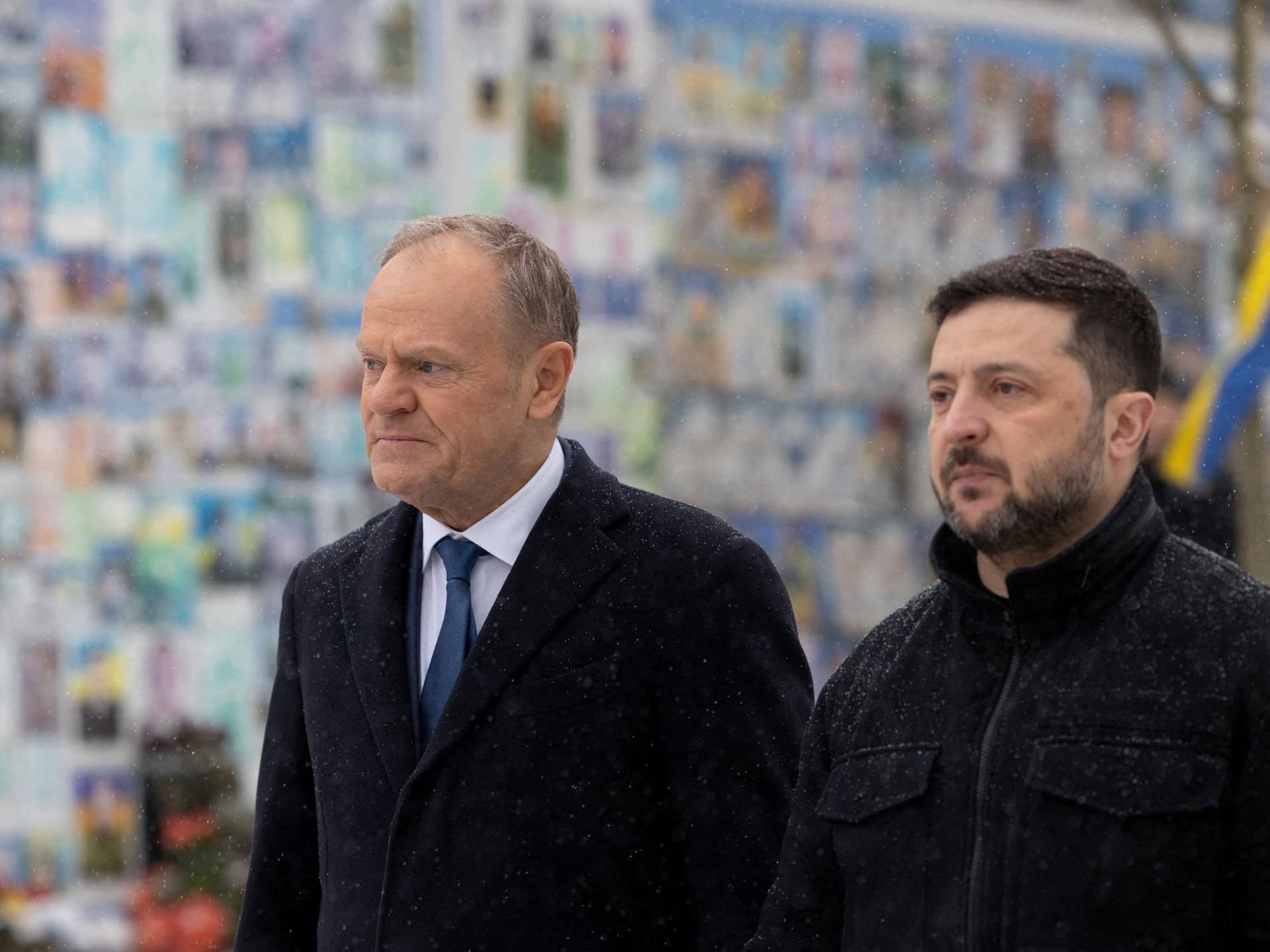
Zelenskyy’s steps prompted a rebuttal from Polish President Karol Nawrocki that grew into a diplomatic spat with no end in sight.
Since Russia’s full-scale invasion began in 2022, Poland has been Kyiv’s logistical backbone, arms and aid supplier and shelter for millions of refugees.
On June 19, Nawrocki stripped Zelenskyy of Poland’s highest state honour, the Order of the White Eagle, because the UPA “remains above all a formation responsible for cruel crimes against” Poles during World War II, Nawrocki said on social media.
In response, Kyrylo Budanov, head of Zelenskyy’s administration, Foreign Minister Andriy Sibiha and former President Petro Poroshenko returned their Polish state awards.
But Anton Shekhotsov, an expert on European far-right groups who heads the Vienna-based Centre for Democratic Integrity, told Al Jazeera the spat is unlikely to sway Warsaw’s support for Kyiv as both nations see Russia as a far bigger, existential threat.
Most of what is now Poland was part of the tsarist empire for more than a century, and after WWII, Warsaw became a pro-Soviet satellite.
“In the Kremlin, they understand that such conflicts don’t have any actual impact on the bigger picture, which is Polish support for Ukraine’s military efforts.”
However, Kremlin-funded media outlets “involved in information warfare against Europe will most likely try to exploit the UPA issue to drive wedges between the two countries,” he said.
On June 19, Poland’s prime minister tried to calm the tension ahead of the Ukraine Recovery Conference of Kyiv’s Western backers that would be held in the northern Polish city of Gdansk, which starts on Thursday.
“A conflict between Poland and Ukraine delights [Russian President Vladimir] Putin and shocks our allies,” Donald Tusk wrote on X. “The frontline lies elsewhere.”
Zelenskyy will skip the conference as Ukrainian Prime Minister Yulia Svyrydenko leads Kyiv’s delegation.
The UPA’s emergence was triggered by a number of factors, including Ukrainian nationalist aspirations, World War II conditions and the Holodomor, a man-made famine in the Soviet Union that killed millions of Ukrainians. Purges of religious clerics, believers and intellectuals, forced Russification and deportations of entire ethnic groups also had an influence.
To some observers, the UPA’s leaders chose what they thought was a lesser evil and sided with Nazi Germany, which invaded the Soviet Union in 1941 and occupied most of what is now Ukraine. The Nazis pledged to disband unpopular collective farms and restore religious freedom, but did not want to make Ukraine independent.
Before taking up arms against them, the UPA participated in the Holocaust and killed tens of thousands of ethnic Poles in western Ukraine, which used to be part of Poland, according to historians and survivors.
“They also killed anyone who tried to protect the Poles,” Nadiya, a 95-year-old Ukrainian woman who lived in the western Ukrainian region of Volyn and witnessed the killings of Poles, told Al Jazeera last year.
She was 12 when crowds of UPA-affiliated youngsters armed with axes, knives and guns stormed into her village in western Ukraine on July 11, 1943, the day still known in Poland as the Volyn Massacre.
Nadiya said she escaped rape and death only because her father hid her in a haystack.
She asked to withhold her last name because she does not feel safe in today’s Ukraine, where the UPA is lionised, and streets are named after its leaders.
Ukraine’s pro-Western leaders “denied, minimised or justified” the UPA’s role in the killings, historian Ivan Katchanovski of the University of Ottawa wrote in 2019.
However, most of the UPA’s members “assisted the Nazi occupational authorities in implementing genocidal policies towards the Jews, Ukrainians, Russians, and Poles by helping to carry out mass executions,” he wrote.
The lionisation of the UPA, especially its leader Stepan Bendera, deeply polarised Ukrainians.
Annual marches to commemorate Bandera’s January 1, 1909, birthday have been routinely followed by angry protest notes from the Polish and Israeli embassies.
The marches are held by far-right and ultra-nationalist groups whose members volunteered in droves to fight Moscow-backed separatists in the southeastern region of Donbas back in 2014.
As poorly armed and barely trained Ukrainian forces could not cope with the rebels, the nationalist units were instrumental in repelling them and limiting their two “People’s Republics” to about one-third of Donbas.
Some observers cite their military prowess as a decisive factor in Zelenskyy’s support of the UPA, even though his Jewish grandfather’s family was killed in the Holocaust.
“Radical Ukrainian nationalists are a free or very cheap military force, and they eagerly keep enlisting youngsters to the front line with the help of heroic symbolism,” Nikolay Mitrokhin, a researcher with Germany’s Bremen University who studied far-right movements, told Al Jazeera.
“Moreover, the military units [the nationalists] formed fight more effectively in general than the regular Ukrainian army,” he said.
Meanwhile, far-right intellectuals spearhead the “indoctrinisation” of Ukraine’s political culture and direct Zelenskyy’s team’s ideological decisions, he said.
The ongoing war with Russia simplifies the popular narrative about anyone who fought for Ukraine’s independence, another expert said.
“Within the context of Ukraine’s war for independence [from Russia], anyone who takes part in this war and sees independence as a value easily associates themselves with those who fought for independence before,” Vyacheslav Likhachev, an expert on Ukrainian and Russian ultra-nationalists, told Al Jazeera.
“The rest is absolutely irrelevant for the popular understanding of history and for the government’s memory policies,” he said.
“Of all the UPA’s enemies, only one matters – the one we’re fighting now, the Moscow Empire – personified by the Soviet Union then and by Russia now,” he said.